
ProWriter

penink

Words that work. Stories that sell.

Research

War in the Gulf, Windfall for the Electric Car

As Gulf tensions push petrol past $2.50, the real winner isn’t oil, it’s the Electric Vehicle.

The Deep Current Investigation March 31, 2026 🔥 ⚡ War · Oil · Energy Transition War in the Gulf,Windfall for theElectric Car As Brent crude smashes past $120 a barrel and the Strait of Hormuz sits blockaded, electric vehicle demand is reigniting worldwide. Coincidence or something far more carefully constructed? By Editorial Research Desk  ·  Energy & Geopolitics  ·  14 min read 01 The Crisis Unfolding Right Now The world woke up on February 28, 2026 to a different energy reality. Following a series of military exchanges involving the United States, Israel, and Iran, the Strait of Hormuz through which nearly 20 million barrels of oil pass every single day effectively closed. What followed was not merely a price spike. It was a structural rupture that energy analysts say may define the decade. PERSIAN GULF REGION · OIL TANKER ROUTE Strait of Hormuz blocked since Feb 28, 2026 · IEA: largest supply disruption in modern history Oil tankers in the Persian Gulf region. The closure of the Strait of Hormuz disrupted an estimated 20 million barrels per day of seaborne oil the largest supply disruption in modern history, per the IEA. Source: CNBC / IEA Brent crude has been hovering stubbornly between $110 and $125 a barrel, and the Iran conflict has shifted from simmering regional tension into a full-blown systemic shock rattling every corner of the global economy. From February 28 to March 27, Brent crude jumped from $72.48 to $112.57 a 55% increase in less than a month. Fertiliser costs have risen 40%. The national average for a gallon of regular gasoline in the US climbed from $2.94 to $3.57 in a single month, according to AAA. +55% Oil price rise since Feb 28 (Brent) 20M Barrels/day blocked at Hormuz +22% EV & hybrid research on Edmunds post-war $120 Brent crude peak, March 2026 “As advocates of renewable energy often say: no blockade can stop the sun from shining.” Chicago Council on Global Affairs, March 2026 02 EVs Were Already Winning Before the War Here is the data point that should stop every oil analyst: global uptake of electric vehicle fleets had already led to avoided oil consumption rising to the equivalent of 70% of Iran’s entire oil exports in 2025 before the war ever began. The transition was already well underway; the war simply made it undeniable. ⚡ ⚡ ⚡ ELECTRIC VEHICLE CHARGING STATION · GLOBAL EV FLEET 2025 IEA: EVs displaced 1.3M barrels/day of oil in 2024 up 30% year-on-year Electric vehicles at a public charging hub. By end of 2024, the global EV fleet reached nearly 58 million more than triple the count from 2021. Source: IEA / Carbon Credits The IEA reports that electric vehicles slashed oil demand by over 1.3 million barrels per day in 2024 a steep 30% jump from 2023, nearly equal to all the oil Japan uses for transportation. By 2030, EVs are projected to replace more than 5 million barrels per day globally, with China’s expanding EV fleet making up nearly half of that impact. According to BloombergNEF, global passenger EV sales are projected to reach nearly 22 million units in 2025 a 25% increase from 2024. In China, the world’s biggest EV market, the existing electric car fleet already accounts for more than $28 billion a year in avoided oil imports. Europe, where EVs accounted for 26% of car sales in 2025, saves about $8 billion annually. “A shift towards EVs would basically protect the economy from downside. That link from oil geopolitics to oil prices to gasoline prices could be broken.” Ember Energy Think Tank, March 2026 (via Fortune) · · · 03 Preplanned? The Research Behind the Suspicion This is the question many observers are now asking out loud: Is it too convenient that every major geopolitical oil shock in modern history has accelerated exactly the kind of energy transition that powerful lobbies spent decades trying to block? Let us examine the documented evidence not speculation, but actual legal filings, academic research, and corporate lobbying records. ⚖️ Michigan vs. ExxonMobil – A Landmark Lawsuit In January 2026, the state of Michigan filed a federal antitrust lawsuit against major oil companies including ExxonMobil and Chevron, alleging a decades-long conspiracy to block the development of clean energy and electric vehicles. Exxon, for example, obtained key patents for developing public EV charging stations and never used them. After developing the first hybrid vehicle prototype, the oil giant abandoned its cutting-edge EV and solar technology research in the early 1980s. The companies then ran advertising and lobbying campaigns attacking EVs while promoting themselves as leading the energy transition even as they pushed technologies that would continue to bolster fossil fuels. The lawsuit also references an elaborate hack-for-hire ring that targeted climate activists, linked to DCI Group, Exxon’s longtime lobbying firm, currently under federal investigation. InfluenceMap research drawing on a dataset compiled by a visiting research fellow at the University of Sussex finds that the oil and gas industry has used a systematic playbook to oppose the energy transition since at least 1967. Analysis of the American Petroleum Institute, FuelsEurope, and Fuels Industry UK records documents over 50 detailed instances of opposition to EV and renewable energy policies. OIL REFINERY · FOSSIL FUEL INFRASTRUCTURE InfluenceMap: Big Oil opposed EV & clean energy policy since at least 1967 An oil refinery at dusk. Research from InfluenceMap and the University of Sussex documents over 50 instances of the American Petroleum Institute opposing green technologies dating back to 1967. Source: InfluenceMap The American Fuel and Petroleum Manufacturers Association announced in 2016 it planned to spend $10 million a year attacking government subsidies for electric vehicles while protecting an estimated $15 billion a year in its own industry subsidies. Meanwhile, major oil companies pursued a dual strategy: contesting rapid EV policy shifts publicly while quietly investing in EV charging networks, battery materials, and hydrogen behind the scenes. Editorial Analysis Was the oil-to-EV transition deliberately timed through geopolitical crisis? The documented evidence does not support

As Gulf tensions push petrol past $2.50, the real winner isn’t oil, it’s the Electric Vehicle. Read More »

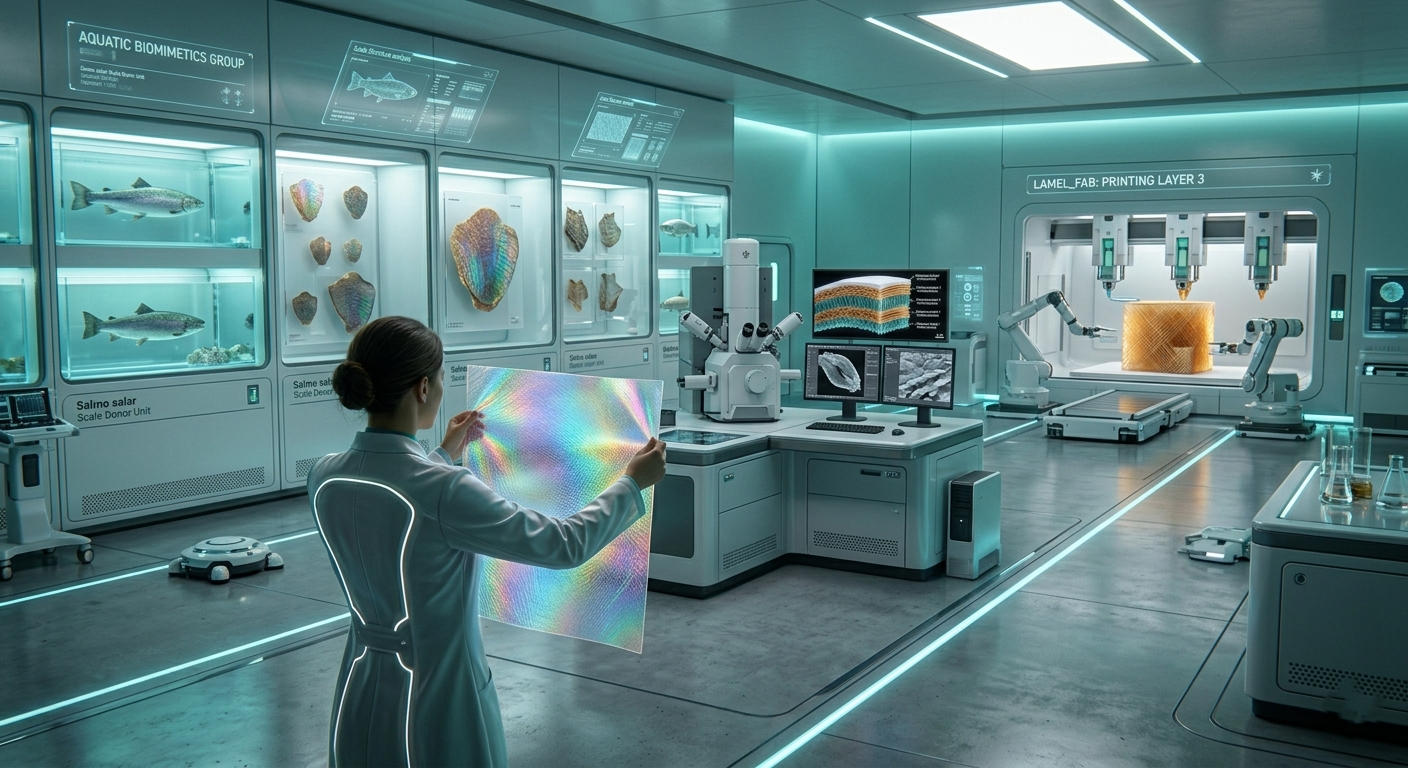
Inside a near-future biomimetics laboratory. A researcher holds a flexible, iridescent film derived from fish scale collagen while behind her, electron microscopes analyse scale microstructure and a 3D printer fabricates the next generation of bio-inspired composite materials.

The Thing You Scrape Off Your Fish Is One of Nature’s Greatest Engineering Secrets

Biology  ·  Materials Science  ·  Biomimetics Fish Scales:Nature’s Hidden Engineering Marvel The microscopic architecture that has quietly outperformed human engineering for 450 million years. And what we’re only now learning to copy. Deep Dive Science Biomaterials 450M Years of R&D The age of fish scale evolution, nature’s longest-running materials lab Pick up a fish. Run your thumb against the grain of its flank. Those small, overlapping plates that pop off so easily, smooth and slightly cool and almost plasticky, have been quietly solving one of materials science’s hardest problems for nearly half a billion years. We’ve spent centuries scraping them down the drain. It turns out we should have been taking notes. Extreme macro of cycloid fish scales showing the overlapping tile geometry and iridescent surface interference patterns. Section 01What Are Fish Scales, Really? At their simplest, fish scales are thin, bony plates that grow out of the skin and overlap like roof tiles. Or, if you prefer a more vivid image, think of the layered plates of medieval chainmail. Each scale is partially covered by its neighbour, creating a continuous, articulated shield that wraps the animal’s entire body. And unlike the shed skin of a reptile, fish scales are living tissue, fed by blood vessels and capable of growth and, remarkably, complete self-repair. There are four main types found across the roughly 34,000 known species of fish. Placoid scales are the tiny, tooth-like structures that make shark skin feel like sandpaper. Ganoid scales are thick, enamel-coated armour plates found on ancient species like gars and sturgeons. Cycloid scales are smooth and rounded, covering most freshwater fish. And ctenoid scales have a slightly serrated rear edge and are found on perch, bass, and many ocean species. Each design is a different evolutionary answer to the same fundamental question: how do you protect a soft body without slowing it down? Scale of the Problem Fish have been refining their scale architecture for approximately 450 million years, which is longer than land vertebrates have existed at all. The designs we study today have been load-tested against more predators, pressures, and environments than any human-engineered material in history. Section 02Layers, Fibres & Minerals: The Architecture Inside a Scale Take a teleost fish scale (the common type found on salmon, carp, or sea bass) and slice it under an electron microscope. What you see looks less like biology and more like an engineer’s blueprint. The structure is strikingly deliberate. Collagen: The Hidden Scaffolding The bulk of a fish scale is built from collagen, the fibrous protein that gives your skin its elasticity and your tendons their tensile strength. But in a fish scale, collagen fibres aren’t tangled randomly. They are organised into thin sheets called lamellae, and in each successive sheet, the fibres run at a different angle to the one below, typically rotating by about 90 degrees per layer. This arrangement is called a Bouligand structure, or twisted plywood architecture. When a force hits the scale, say a predator’s bite, a crack begins to form. But as that crack travels through each new layer, it must change direction completely. Every rotation drains energy from the advancing fracture. What might have been a clean, catastrophic split becomes a slow, winding journey through dozens of layers. More often than not, it stops entirely before reaching the other side. Minerals: The Hard Outer Shell The outermost surface of the scale is mineralised with hydroxyapatite, the same calcium phosphate compound that hardens our bones and teeth. This crust provides hardness and scratch resistance at the point of contact. Beneath it, the flexible collagen layers absorb and redistribute impact energy. Hard outside, tough inside. It is the exact same logic behind modern safety helmets, and fish arrived at this design hundreds of millions of years before human engineers did. Cross-section of a fish scale revealing the alternating collagen lamellae layers and the hard hydroxyapatite mineralised surface above. Section 03The Science of Toughness Here is the fundamental engineering problem that fish solved, one that human materials scientists are still wrestling with today. Strength and flexibility are usually opposites. Glass is hard but shatters. Rubber bends but offers no protection. The entire history of materials engineering is, in some sense, a search for the territory in between. Fish scales occupy that territory with quiet confidence. Mechanical Strength and Flexibility Research published in journals including Nature Materials and Acta Biomaterialia has used nanoindentation to measure the mechanical properties of scales with great precision. Nanoindentation involves pressing tiny calibrated probes into scale surfaces to quantify how they respond to force. The mineralised surface has a hardness comparable to bone. But the underlying collagen structure gives the scale a toughness, or resistance to fracture, that pure mineral could never match alone. The result is a composite that is harder to break than either of its components individually. Layered Architecture and Crack Resistance When MIT researchers Christine Ortiz and Mary Boyce analysed the scales of Polypterus senegalus, an ancient and heavily armoured freshwater fish, they found that cracks forced to travel through the twisted plywood structure required vastly more energy than cracks moving through homogeneous materials. The whole was many times tougher than the sum of its parts. The same principle has since been found in nacre (mother-of-pearl) and mantis shrimp clubs, and it is now considered one of nature’s signature structural tricks. Hydrodynamic Advantages Protection, however, is only half the story. A fish also has to move, and move fast. Researchers at Harvard found that as a fish bends during swimming, the scales on the outside of each curve fan apart slightly while those on the inside compress together. This distributes bending stiffness dynamically along the body, allowing tight turns without the skin buckling or wrinkling, which would spike drag. In some species, the microstructure of the scale surface creates tiny vortices that reduce friction drag in much the same way that the dimples on a golf ball improve its flight. Computational fluid dynamics render showing how water flows around a fish

The Thing You Scrape Off Your Fish Is One of Nature’s Greatest Engineering Secrets Read More »

Fireflies (jugnu) light up a summer meadow at dusk — a phenomenon that inspired one of biology's most powerful laboratory tools.

From a Summer Night to a Cancer Lab: The Firefly’s (Jugnu’s) Extraordinary Journey

New Interesting Facts How the Firefly’s Glow Became One of Science’s Greatest Tools A tiny insect’s magical light called bioluminescence has quietly revolutionised modern medicine, drug discovery, and our understanding of how life works at the cellular level. Biology & Biotechnology 15 min read Section 01 That Magical Glow on a Summer Night You’ve probably seen them tiny sparks of light drifting through the dark, rising from the grass on a warm evening. In South Asia, people call them jugnu. In the West, we call them fireflies or lightning bugs. Children chase them. Poets write about them. And for thousands of years, that mysterious golden glow was simply… magic. But scientists looked at that same glow and saw something else entirely. They saw a question: How does a living creature produce light without heat, without electricity, and without a flame? The answer to that question turned out to be one of the most powerful discoveries in modern biology. Today, the firefly’s light or more precisely, the chemistry behind it is used to detect cancer, track infections, test new drugs, and even monitor pollution in rivers and soil. A tiny insect has become one of science’s greatest tools. Let’s start from the beginning and follow the glow from the firefly’s belly all the way to the hospital lab. 🎨 Hero Illustration Fireflies (jugnu) light up a summer meadow at dusk a phenomenon that inspired one of biology’s most powerful laboratory tools. Section 02 What Is Bioluminescence? (And How Does It Work?) Bioluminescence simply means “living light.” It’s light produced by a living organism through a chemical reaction happening inside its body. Fireflies do it. So do certain deep-sea fish, glowing mushrooms, and even some bacteria. But fireflies are the most famous and the most useful to scientists. Here’s the cool part: this light produces almost no heat. Scientists call it “cold light.” Your phone torch gets warm. A candle flame is scorching hot. But the firefly’s glow? You could hold one in your hand and feel nothing because the energy is being converted directly into light, not wasted as heat. Meet the Key Players The firefly’s light-making factory uses just four ingredients: Luciferin The fuel a small molecule that “burns” to make light + Luciferase The engine a protein (enzyme) that triggers the reaction + ATP The spark the cell’s universal energy currency + Oxygen The air required for the reaction to proceed → ✦ Light! Pure, cold, golden-green photons Simple Analogy Think of it like baking. Luciferin is the dough the raw material. Luciferase is the oven it transforms the dough into something new. ATP is the electricity powering the oven. And oxygen is the heat that makes the reaction happen. Without any one of these, you don’t get your bread and the firefly doesn’t glow. Step by Step: How the Glow Happens Step 1: The firefly’s belly (called the lantern organ) contains special cells packed with the enzyme luciferase. Step 2: When the firefly wants to flash, it opens tiny air tubes to let oxygen rush in. Step 3: Luciferase grabs a molecule of luciferin and a molecule of ATP, and combines them with the oxygen. Step 4: This chemical reaction kicks a tiny particle of light called a photon out of the molecule. That photon is the glow you see. Step 5: The firefly controls the flash by controlling the oxygen supply like a living light switch! 🎨 Chemical Reaction Diagram The four ingredients of firefly light: luciferin (fuel), luciferase (enzyme), ATP (energy), and oxygen combine to release a cold, heatless photon. Section 03 How Scientists Make Specific Cells Glow Here’s where things get really exciting. Scientists realised: what if we could take the recipe for making light the luciferase gene and give it to other living cells? What if we could make cancer cells glow? Or brain cells? Or any cell we wanted to watch? It turns out, we can. The Luciferase Gene A Biological Blueprint Every living thing is built using genetic instructions written in DNA. The firefly carries a gene a section of DNA that contains the instructions for making luciferase. Scientists can copy this gene and insert it into any cell they want to study. This process is called genetic engineering or gene insertion. Think of it like copying a recipe from one cookbook and pasting it into another. The kitchen (the cell) reads the recipe and starts cooking (making luciferase). Once the cell has the luciferase gene, all you need to do is add the fuel (luciferin from outside), and the cell will glow. The Secret Power of Promoters Scientists don’t just insert the luciferase gene anywhere. They attach it to a special molecular switch called a promoter. A promoter is a sequence of DNA that acts like an “ON switch” it only activates the gene it’s attached to under specific conditions. For example, there are promoters that only switch on inside cancer cells, or only inside brain neurons, or only when a certain virus is present. This means: the luciferase gene only becomes active and the cell only glows when the exact condition the scientist cares about is happening. The light becomes a signal. A message written in photons. Real-World Examples Glowing cancer cells: Scientists insert the luciferase gene attached to a cancer-specific promoter into tumour cells. The tumour glows, and researchers can watch it grow, shrink, or spread in a living animal without surgery. Glowing neurons: Neuroscientists can make nerve cells glow when they fire an electrical signal, essentially watching thoughts happen in real time. Glowing genes: Scientists attach luciferase to any gene they want to study. When that gene turns on, light turns on. When the gene turns off, light disappears. The light level = gene activity. 🎨 Gene Insertion Illustration The luciferase gene is extracted from firefly DNA and delivered into a target cell via a viral vector the cell then begins producing its own light. Section 04 Real Research Applications: Where the Glow Goes to Work The

From a Summer Night to a Cancer Lab: The Firefly’s (Jugnu’s) Extraordinary Journey Read More »

Scroll to Top